
Wheel Alignment: What It Means, Why It Matters, and What It Costs You If It’s Wrong
If your car has started pulling to one side, or you’ve noticed one edge of a tyre wearing faster than the rest, wheel alignment is usually the cause. At Great North Auto Services, we check alignment on cars from across the Harrogate and Knaresborough area every week, and it’s one of the most common issues we find after a pothole strike, a kerb knock, or suspension work. Here’s what alignment actually means, how to spot a problem, and what it costs you if it’s left uncorrected.
What Does Wheel Alignment Mean?
Wheel alignment primarily refers to the toe angle and the camber angle
*caster angle is also measured but is not usually such a big factor as camber and toe.
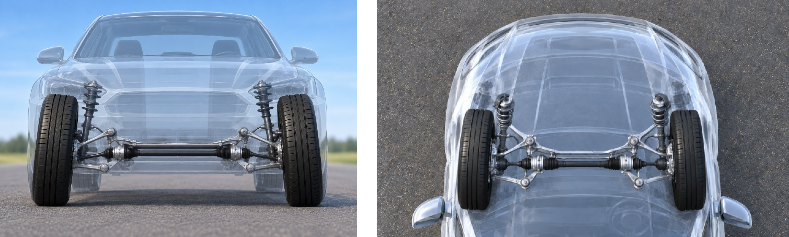
Camber is the amount the wheel leans inwards or outwards.
Toe is the amount the wheel points inwards or outwards.
The wheel is misaligned if the camber or toe do not match the manufacturer specified values.
What is the Unit of Alignment, And How Much Misalignment is “Too Much”?
Strictly speaking, the unit of alignment is degrees, and that is what manufacturers specify the alignment in. We often use millimetres to communicate alignment data though. So rather than say the toe is misaligned by 0.5 degrees, we would say its misaligned by 3 mm – the same thing but easier to understand and visualise.
Typically, anything more than 1 mm of toe misalignment should be corrected. Camber misalignment has less impact so anything above 2 mm should probably be corrected. Wheels and tyres are far more sensitive to toe alignment than camber, so even a small toe misalignment will have an impact.
Should All Wheels Always Be Zero Camber And Toe?
No, and that’s by design. Zero camber and zero toe is the most efficient way to roll a tyre in a straight line so it gives the lowest wear and lowest fuel consumption. However, vehicles are almost never designed to have zero camber and zero toe.
Vehicles have to go around corners as well though, and when they do they roll towards the outside. So manufacturers build in some camber leaning inwards at the top to offset the outwards roll when cornering.
Toe is also a very important factor in cornering performance and stability. If the wheels start to point outwards, the car can become less stable in all driving conditions – even in straight line braking. So, manufacturers tend to design with some toe inwards to ensure the vehicle is stable.
You must follow manufacturer specifications for what suits your vehicle best in the compromise of low wear and fuel consumption, versus cornering, versus stability.
Why Doesn’t The Alignment Just Stay The Same As The Car Was Built?
Because the suspension links and joints holding your wheel in position can shift or bend slightly every time you hit a pothole or clip a kerb. Those same links and joints are what we adjust to bring alignment back to specification.
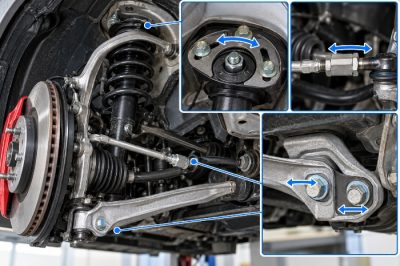
Alignment can also shift after suspension or chassis work, since components rarely go back into exactly the same position. If you’ve had any suspension work done recently, it’s worth having the alignment checked as a matter of course.
How Can I Tell If My Wheels Are Misaligned?
It’s not always easy to tell – or at least not as easy as you’d think. Most people experience misalignment as a pulling to one side when heading straight, and that is indeed a strong indicator you have alignment problem, but it doesn’t always happen that way. For example, if both front wheels are pointing outwards, then your car may continue to travel straight without pulling to one side, even though both wheels are misaligned.
The tyre wear is also a good indicator: if you see excessive wear in one area of the tyre, then it may well be misaligned. The problem is that this only becomes apparent after the damage is done.
The only way to tell for sure if your wheels are misaligned, before damage is done, is to measure the alignment with professional 3D alignment equipment.
How Do You Measure Alignment At Great North Auto Services?
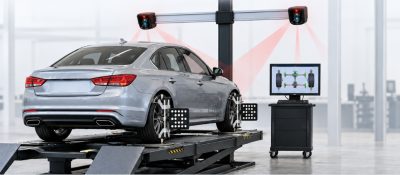
Both our Harrogate and Knaresborough workshops use a 3D alignment system with digital marker boards fitted to each wheel, read by an overhead camera. The system holds a database of manufacturer alignment settings for your specific vehicle, so it measures your wheels and shows exactly how far each angle is out against the correct figures.
This car shown has just had front suspension changed, so the front wheel toe angles are both showing “red” for misaligned and require adjusting. When it’s all adjusted, we remeasure and make sure everything is shown as “green” for aligned.
What Are The Benefits Of Correct Alignment?
Correct alignment saves fuel and reduces emissions, your tyres will last longer before replacement and the vehicle performance and stability will be improved.
A study in 2024 measured fuel consumption and tyre wear showed that incorrect alignment of just 1.5 mm on both front tyres (0.4 deg across the axle) will increase fuel consumption by 1.5% and reduce tyre life by over 30%.
You may have experienced this yourself in the past, when you have to replace tyres because there is high wear caused by misalignment, despite the rest of the tyre having more life left. Its infuriating isn’t it!
Will It Save Me Money If My Tires Are Properly Aligned?
Yes, correct alignment will always save you running costs (fuel) and reduced repair costs (tyres). The amount you will save depends on the mileage you do, and the cost of your tyres, as well as the amount of misalignment, so we’ve calculated a couple of examples for you (based on fuel price of £1.75 per litre) of what misalignment costs you:
- If you have a typical family saloon, your tyres cost around £100 each (fitted) and you do 12000 miles per year and achieve 40 mpg fuel economy. If your front tyres are misaligned by just 1.5 mm each, it could cost you £35 in additional fuel per year, and £66 in costs for faster tyre replacement, so a potential £101 cost to you
- A higher performance car may have tyres costing around £100 each (fitted) and you do 12000 miles per year and achieve 30 mpg fuel economy. If your front tyres are misaligned by just 1.5 mm each, it could cost you £80 in additional fuel per year, and at least £130 in costs for faster tyre replacement, so a potential £210 cost to you
So correcting misalignment can save you over £100 per year, and you avoid that sinking feeling of having to replace tyres that are only worn in one small part of the tread!
Do All Tyres Behave The Same Way?
Broadly, yes. Some tyres are harder wearing than others, some are designed for efficient running, and some are designed for better grip, but the impact of misalignment is broadly similar across them all.
What really makes a different though is the tyre profile. This is the height of the tyre relative to the overall wheel size, and the trend is towards lower profile tyres, especially on premium or high-performance vehicles.
Lower profile tyres have much less “forgiveness” in the side wall, so they are impacted more by misalignment. You may have noticed this if you run low profile tyres, that its much more common to see the impact of misalignment, and the impact shows up much sooner.
If you run low profile tyres, the potential costs of misalignment are higher.
What Can Go Wrong?
Sometimes it might be difficult to align all wheels. Some cars do not have easy adjustment for camber for example, and none at all for caster. Older vehicles often have fixed axle rear wheels that do not even have toe adjustment, so we can only adjust the front wheels. This is not as good as all-wheel alignment for the performance of the tyres.
Joint and links can seize up over time, so they can’t be adjusted as they were designed to be. In this case, we have to decide whether it’s worth changing the link or joint so that we can adjust the alignment. Sometimes it is, sometimes it isn’t, we would talk it through with you.
When Should I have My Alignment Checked
We’d recommend an alignment each time tyres are changed, or annually if sooner. We would also stipulate an alignment check whenever suspension is repaired. It’s also worth checking if you have even a small accident, or you encounter a pothole, particularly if the steering doesn’t feel right afterwards.
Also, check your tyre wear periodically, or have us do it for you. It’s not ideal to damage your tyres in order to see the misalignment, but it’s better to fix it part way through the tyre life, rather than not at all.
And remember that if you run low profile tyres, take extra care with your alignment checks.
Book an alignment check at either of our workshops in Harrogate and Knaresborough, and we’ll check your alignment while you wait.


© Great North Auto Services - 2026
